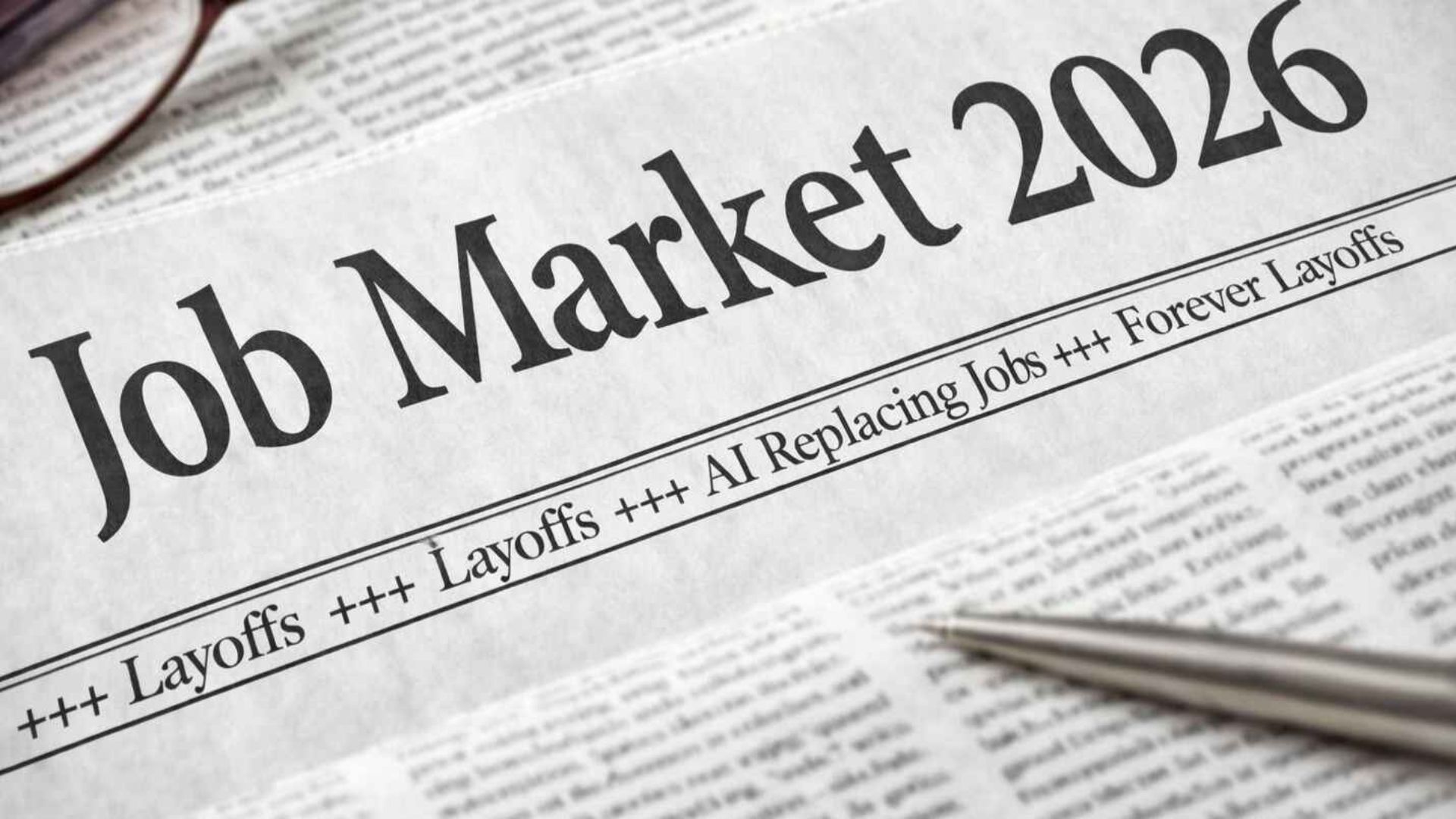
The Truth About AI and Job Cuts from 2020 to 2026


.avif "Kaivan Dave")

According to a new analysis, only 16% of global layoffs between 2020 and 2026 are actually caused by AI automation.
The Real Reason behind Job Cuts
Layoffs were happening left and right in the last 2 years. The headlines scream about AI stealing jobs.
But if we look at the actual data, AI is not the biggest reason companies are cutting jobs.
An analysis of 15,000 layoff events from 2020 to 2026 found that AI accounted for only attributed for 16% of global job cuts.
Here are the top 6 reasons for layoffs in this decade so far:

1) Overexpansion
Out of the 3.4 million employees laid off, about 17.9% were let go because companies determined their roles were no longer needed.
What happened is that during 2021-22, many firms expanded quickly, especially in the software engineering job market. Tech companies went on unprecedented hiring sprees, betting that explosive growth would continue forever.
Many companies believed rapid digitization was urgent, which led to aggressive hiring as they raced to launch new products and become early leaders in the evolving market.
However, when reality hits and demand softens, that extra capacity becomes a liability. Revenue was not increasing that fast, and the fixed payroll of so many employees became a problem.
Importantly, layoffs tied to overexpansion are usually corrective rather than strategic: the company is not always changing its business model so much as shrinking to a realistic size. That explains why overexpansion can be the single biggest headline cause of layoffs, even when other drivers are present.
A recent Wall Street Journal analysis also revealed that many U.S. companies are still cutting jobs to reverse aggressive hiring during the pandemic boom. Companies are now trimming payrolls to restore efficiency, reduce management layers, and protect profit margins.
The biggest hiring drops happened in management, consulting, and IT roles.
Recent Layoffs: Salesforce, UPS, Amazon
2) M&A Activity
Mergers and acquisitions (M&A) were the second reason for global layoffs at 17.4%.
Mergers and acquisitions trigger massive job losses becausewhen two companies combine, functions such as finance, HR, sales operations, and IT are duplicated. So, firms then remove the duplicate roles to achieve the cost savings that justified the deal.
Global M&A deal value was up significantly during 2025, with some measures showing a 10% increase in deal activity when compared with the previous year. Low interest rates in prior years and large pools of investment capital made acquisitions more financially feasible in the last couple of years.
Recent Layoffs: Vimeo, UBS, Paramount
3) Cost-Cutting
Cost-cutting is still a big reason behind layoffs, about 16.7% of them, which shows companies are still feeling the pressure to stay profitable.
This is the most classic reason companies give when profits fall or growth slows. Unlike a targeted restructuring, “cost-cutting” is a broad category that can include everything from freezing hiring to eliminating entire teams.
When margins shrink, finance leaders and boards often mandate headcount reductions because payroll is typically the largest controllable operating expense.
This is also an effect of the overexpansion that happened at the beginning of this decade.
However, cost-cutting is also mostly an excuse for introducing automation into the workflow, as well as offshoring.
Reports from Challenger, Gray & Christmas have regularly confirmed that cost-cutting was the top cited reason for announced layoffs in the US for the years 2024 and 2025.
Recent Layoffs: Cigna, Block, Washington Post, Oracle, Mastercard, Nike
4) AI Automation
AI automation already makes up 16.4% of layoffs, making it the fourth biggest reason right now.
Adoption of AI can automate certain tasks (data entry, basic analysis, routing, and routine customer interactions), making some roles redundant.
However, most companies report AI as part of a broader efficiency or transformation program, not the sole trigger for mass cuts.
There’s also a signaling effect. Companies announce AI initiatives to show innovation and future-readiness, and sometimes cite AI as a reason for workforce changes even when the practical automation impact is small.
A MIT/Oak Ridge National Laboratory study using the Iceberg Index found that AI is currently capable of replacing about 11.7% of the U.S. workforce, which amounts to roughly 151 million workers.
The other two reasons are restructuring and Market Downturns, but they are directly connected to cost-cutting and restructuring efforts.
The analysis also revealed that Energy, Finance, and Technology are the biggest industries that were affected by all the changes we saw in this decade.
Recent Layoffs: Baker McKenzie, Workday, Pinterest, Tailwind, Autodesk
Bottom Line
From a corporate communications perspective, AI provides several advantages as a layoff justification. It sounds inevitable, and it shifts blame. Nobody has to take responsibility.
But now we are seeing that even the markets are not taking the AI excuse seriously. Many are looking deeper into the numbers and are finding out that the real reason is actually much more complicated.
Still, while executives debate efficiency metrics, real people lose their livelihoods. The AI excuse adds insult to injury because it implies these workers are obsolete.
Table of Contents
Related articles

Nvidia CEO says AI will change Every Job and Make Workers Busier than Ever
AI won’t give workers more free time warns Nvidia CEO Jensen Huang Instead it will transform every job and make survivors busier than ever.

Microsoft AI CEO on How Vibe Coding Changed Software
Microsoft AI CEO Mustafa Suleyman explains how vibe coding has lowered the barrier to software, making it easier for anyone to build apps using AI.

7 AI-Proof Careers That Will Survive 2026 and Beyond
Worried about AI taking your job? Explore 7 AI-proof careers that will survive in 2026, where automation cannot replace human judgment.

Nike Layoffs Affect 1% of Corporate Workers in Latest Round of Job Cuts
Nike to cut 1% of corporate workers in US and Canada as part of business restructuring efforts. Employees find out by Sept 8 if they're affected.