20 Capital One Behavioral Interview Questions (2026)


.avif "Kaivan Dave")
If you're preparing for an interview with Capital One, you'll need to get comfortable with behavioral questions.
Interviewers will ask you to recall specific moments from your career. Your answers reveal everything from your problem-solving approach to how well you align with Capital One's culture and values. Expect stiff competition, as Capital One is ranked among Fortune’s 100 Best Companies to Work For.

In this guide, you'll discover exactly what Capital One looks for in candidates, the most commonly asked behavioral interview questions, and proven strategies to craft compelling answers that get you hired.
Why Does Capital One Ask Behavioral Questions?
Capital One uses them because past behavior is one of the best predictors of future performance. When you describe how you've handled challenges in the past, interviewers gain insight into how you'll approach similar situations in your new role.
Unlike hypothetical questions that let you speculate about what you might do, behavioral questions require concrete examples. This format makes it easier for interviewers to evaluate your genuine capabilities.
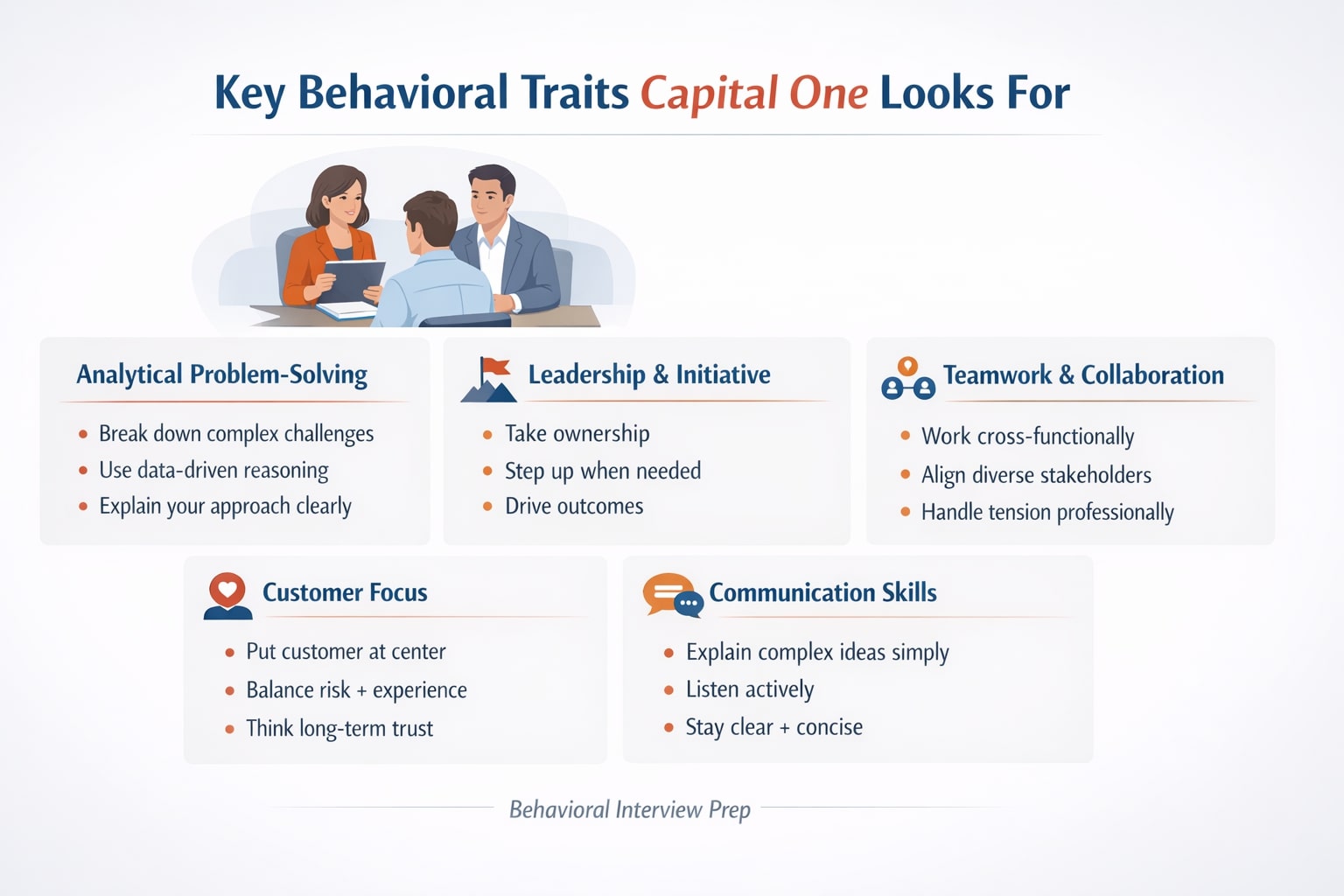
Key Behavioral Traits Capital One Looks For
Capital One is building teams of people who can drive innovation in financial services. During your behavioral interview, expect questions designed to assess these competencies:
- Analytical Problem-Solving: Can you break down complex challenges and develop data-driven solutions? Capital One values candidates who approach problems methodically and can explain their reasoning clearly.
- Leadership and Initiative: Even if you're not applying for a management role, Capital One wants to see that you can step up when needed. They're looking for examples of times you've taken ownership of outcomes.
- Teamwork and Collaboration: Financial services require cross-functional coordination. You'll need to demonstrate that you work effectively with diverse personalities and departments.
- Customer Focus: Whether you're in tech, operations, or customer-facing roles, Capital One expects you to keep the customer at the center of your decision-making.
- Communication Skills: Your ability to articulate complex ideas simply and listen actively matters.
Core Values of Capital One
Your behavioral answers should reflect Capital One's values. Understanding these principles will help you frame your examples in ways that resonate with interviewers:
- Excellence and Innovation: Capital One wants to hear about times you've improved processes or introduced creative solutions.
- Integrity and Respect: Trust is everything in financial services. Your examples should demonstrate ethical decision-making and respect for colleagues and customers alike.
- Customer Commitment: Every role at Capital One eventually serves customers. Show how you've gone above and beyond to meet customer needs or solve their problems.
- Diversity and Inclusion: Capital One values teams that bring different backgrounds, experiences, and viewpoints to the table.
STAR Framework to Answer Behavioral Questions
The STAR method is your secret weapon for delivering clear, compelling answers that interviewers love. Here's how to structure your responses:
Situation: Set the stage with relevant context. Where were you working? What was happening? Keep this brief; a sentence or two is usually enough.
Task: Explain your specific responsibility or the challenge you faced. What needed to be accomplished? What was at stake?
Action: This is the meat of your answer. Walk through the specific steps you took to address the situation.
Result: Share the outcome. Whenever possible, quantify your results with numbers, percentages, or other metrics.
The STAR framework keeps your answers organized and ensures you don't ramble or leave out details. Practice structuring several stories using this method before your interview, and you'll feel much more confident when the questions start flying.
10 Most Asked Capital One Behavioral Interview Questions & Answers
The following questions are among the most common behavioral interview questions asked at Capital One:.
1. How do you handle working under pressure and tight deadlines?
Describe a situation where you faced a challenging deadline. Explain how you broke the work into manageable pieces, communicated with stakeholders about priorities, and stayed focused even under pressure.
Sample answer: "In my previous role as a financial analyst, we had a regulatory report due in three days instead of the usual two weeks. I immediately created a prioritized task list, identifying which sections were most complex and needed the most time. I communicated with my manager about resource needs and coordinated with two colleagues to divide the work efficiently. I also set up checkpoints every 8 hours to ensure we stayed on track. Despite the pressure, we submitted the report 2 hours before the deadline with zero errors, and it was approved without any revisions needed."
2. Tell us about a time you improved a process at work.
Start with a process that was inefficient or problematic. Explain what you identified as the issue, then walk through the changes you implemented. Finish with measurable results like "reduced processing time by 30%" or "eliminated 15 hours of redundant work per week."
Sample answer: "At my last company, our expense reporting process required employees to manually enter data from receipts into three different systems. I noticed this was taking our 50-person team an average of 2 hours per month each. I researched automation tools and proposed implementing an expense management platform that could scan receipts and sync data across systems. After getting approval, I led the implementation and trained the team. Within three months, we reduced expense processing time by 65% and eliminated nearly all data entry errors. The company saved approximately $40,000 annually in productivity costs."
3. Describe a time you had to resolve a difficult situation or conflict on the job.
Outline a specific conflict, maybe a disagreement between team members, a clash over project direction, or tension with another department.
Sample answer: "Two members of my team had a serious disagreement about the approach for a major client presentation. One wanted a data-heavy approach while the other advocated for a storytelling format, and tensions were affecting the whole team. I scheduled individual conversations with each person to understand their perspectives and concerns. Then I brought them together for a collaborative session where I discussed our client's specific needs and preferences. We realized that combining both approaches. The presentation was a success, and both team members felt heard."
4. Describe a situation where you had to handle a customer complaint.
Share a story about a frustrated or upset customer. Describe how you listened actively to understand their concern, showed empathy for their situation.
Sample answer: "A customer contacted us extremely frustrated because a billing error had resulted in a service interruption during a business period. I first listened without interrupting. I acknowledged the impact this had on their business and apologized sincerely. I immediately investigated the root cause and corrected their billing within the hour. I also proactively credited their account for the inconvenience and personally followed up to ensure their service was fully restored."
5. Describe a time you took a leadership role.
Think of a time when you took charge of a project, mentored a colleague, or rallied a team during a challenging period. Explain what motivated you to step into that leadership role and how you approached it.
Sample answer: "When our team lead went on unexpected medical leave for six weeks, our major product launch was at risk. Although I wasn't the most senior person, I volunteered to coordinate our efforts. I scheduled daily stand-ups to maintain momentum and redistributed tasks based on everyone's strengths. We successfully launched on schedule, and the product exceeded first-quarter sales targets by 20%."
6. What makes you a good fit for Capital One's culture?
Reference specific Capital One values like innovation, collaboration, or customer commitment. Then tie each one to concrete examples from your experience.
Sample answer: "I'm drawn to Capital One's emphasis on innovation and data-driven decision making. In my current role, I've consistently looked for ways to use analytics to solve business problems. For example, I built a predictive model that improved our customer retention by identifying at-risk accounts early. I also value Capital One's collaborative culture. Finally, Capital One's commitment to doing the right thing for customers resonates with me. I believe that sustainable business success comes from genuinely serving customer needs."
7. Tell me about a time you learned something new.
Describe a situation where you had to acquire a new skill or knowledge area quickly. Explain how you approached the learning process and how you applied that new knowledge to achieve better results.
Sample answer: "When my company decided to migrate to a cloud-based infrastructure, I had no experience with cloud architecture. Rather than wait for formal training, I enrolled in online courses on AWS fundamentals, spent evenings working through hands-on labs, and joined a cloud computing community where I could ask questions. Within six weeks, I had earned my AWS Solutions Architect certification. I applied this knowledge to successfully migrate three applications to the cloud, which reduced our infrastructure costs by 35% and improved system reliability."
8. Describe a situation where you have had to work as part of a diverse team.
Share an example of working with teammates who brought different viewpoints or experiences to the table. Highlight how you used those differences to arrive at a better solution than any one person could have developed alone.
Sample answer: "I worked on a product development team with members from five countries, spanning three time zones, with backgrounds in engineering, design, marketing, and customer service. Initially, our different communication styles and priorities created friction. I suggested we start meetings by having each person share their perspective before jumping into solutions. This revealed that what engineering saw as a 'minor interface issue' was actually a major accessibility barrier for customers with disabilities. By actively incorporating everyone's expertise, we designed a product that was both technically robust and genuinely user-friendly for all customers."
9. Describe a time you set a goal for yourself and followed through.
Pick a meaningful goal, maybe a professional certification, a challenging project target, or a personal development objective. Explain what motivated you to set that goal and the specific steps you took to pursue it.
Sample answer: "I set a goal to earn my CFA charter while working full-time, knowing it would require approximately 1,000 hours of study over three years. I created a detailed study schedule, blocking out early mornings and weekends. When I failed Level II on my first attempt, I was discouraged but used the feedback to identify weak areas and adjusted my study approach. I found a study group for accountability and hired a tutor for quantitative methods. Eighteen months later, I passed Level II, and six months after that, completed Level III."
10. Describe a time you made a mistake. How did you handle it?
Be honest about a genuine mistake (nothing trivial, but also don't confess to something catastrophic). Explain what went wrong, then quickly shift to what you did about it.
Sample answer: "Early in my career, I sent a client proposal with pricing that was 30% lower than intended due to a spreadsheet formula error. When I discovered the mistake the next morning, I immediately informed my manager and called the client directly to explain the error before they made any decisions based on incorrect information. I took full responsibility and provided the corrected pricing with a detailed explanation. The client appreciated the honesty and signed the contract at the correct price. I then created a proposal review checklist and implemented a two-person verification process for all pricing, which our team still uses today."
Bonus 10 Capital One Behavioral Interview Questions & Answers 2026
As hiring shifts in 2026, Capital One interviews are moving beyond classic leadership stories. These questions are designed to understand how you think, adapt, and make decisions in a tech-heavy, fast-changing environment.
11. Tell me about a time you used technology or automation to improve your work.
This question reflects the reality that AI and automation are now part of daily workflows. Interviewers want to see awareness, not blind dependence.
Sample answer:
“In my previous role, I noticed we spent hours each week manually compiling reports from multiple tools. I introduced a simple automated workflow that pulled the data together and flagged inconsistencies. I still reviewed the final output before sharing it, but the automation reduced prep time by nearly 50%. This allowed the team to spend more time analyzing insights instead of gathering data.”
12. Describe a time you had to make a decision without having all the information.
In 2026, companies value people who can act responsibly under uncertainty.
Sample answer:
“While working on a time-sensitive project, we had incomplete customer data due to a system outage. Instead of waiting, I identified what information was critical versus optional and made assumptions explicit. I shared the risks clearly with stakeholders and proposed a phased decision. This approach helped us move forward while minimizing downside risk.”
13. Tell me about a time you had to learn something completely new to stay effective.
Learning speed is becoming more important than prior experience.
Sample answer:
“When my team adopted a new analytics platform, I had no prior experience with it. I set aside focused time each day to learn the basics, tested features on smaller tasks, and documented what I learned. Within two weeks, I was contributing fully and later helped onboard others, which reduced team dependency on external support.”
14. Describe a time you disagreed with a recommendation driven by data or a tool.
This question tests judgment and critical thinking, not technical skill.
Sample answer:
“A data model suggested cutting support resources in one region. While the numbers supported it, I noticed customer complaints were rising in that area due to a recent service change. I raised this concern, supported it with qualitative feedback, and recommended delaying the decision. Leadership agreed, and follow-up analysis later confirmed the risk.”
15. Tell me about a time you had to balance speed with quality.
Capital One values execution, but not at the cost of trust or accuracy.
Sample answer:
“During a tight deadline, leadership needed quick insights for a decision. I focused on delivering a high-confidence summary instead of a full analysis. I clearly stated what was validated versus directional. This allowed leadership to act quickly without misinterpreting the data.”
16. Describe a time you handled sensitive data or an ethical concern.
With increased regulation and AI usage, ethical judgment matters more than ever.
Sample answer:
“I once noticed that sharing certain internal data externally could create compliance risks. I paused the process, raised the concern with my manager, and suggested an alternative approach that met the business goal without exposing sensitive information. It delayed the deliverable slightly but protected the organization from long-term risk.”
17. Tell me about a time you had to explain a complex decision to someone who disagreed with you.
This tests communication and emotional intelligence.
Sample answer:
“A stakeholder strongly disagreed with a prioritization decision I made. Instead of defending it immediately, I walked them through the constraints, trade-offs, and data behind the decision. I also acknowledged what their perspective highlighted. While they didn’t fully agree, they understood the reasoning and supported the outcome.”
18. Describe a time you improved the way your team worked, not just the outcome.
In 2026, companies care about sustainable performance, not one-off wins.
Sample answer:
“I noticed recurring confusion around ownership during projects. I introduced a simple responsibility framework and clearer handoff checkpoints. Over time, this reduced rework and improved collaboration. The biggest impact wasn’t one project, but smoother execution across multiple initiatives.”
19. Tell me about a time you had to rethink your approach after feedback or results didn’t go as expected.
In 2026, Capital One wants people who can adjust quickly without getting defensive. This question checks adaptability and learning maturity.
Sample answer:
“On a project I led, early results showed our solution wasn’t having the impact we expected. Instead of pushing forward, I reviewed the data and asked for feedback from both stakeholders and end users. I realized my initial assumptions were off. I adjusted the approach, simplified the solution, and ran a smaller test before scaling again. The revised version performed significantly better, and the experience taught me to treat early results as signals, not final judgments.”
20. Describe a time you had to prioritize long-term impact over short-term results.
This question reflects how Capital One balances speed, risk, and sustainability, especially in data-driven and regulated environments.
Sample answer:
“During a planning cycle, I was under pressure to deliver quick results by cutting corners on documentation and validation. While that would have shown short-term progress, I knew it could create issues later. I proposed a phased plan that delivered a smaller win quickly but protected long-term quality and compliance. Although it took slightly longer upfront, it prevented rework and built trust with leadership over time.”
Conclusion
Capital One's behavioral interview process is your opportunity to showcase the experiences that make you an exceptional candidate.
Remember, these questions aren't designed to trip you up. Your past experiences are proof of your capabilities, and when you articulate them clearly and authentically, you give interviewers every reason to see you as their next great hire.
Table of Contents
Related articles

How to Answer "What Is Your Leadership Style?"
Learn how to effectively answer "What Is Your Leadership Style?" with practical tips and examples to showcase your strengths in job interviews.

How to Answer "Tell Me About When You Learned Something New"
Discover effective strategies to answer the interview question "Tell Me About When You Learned Something New" with confidence and clarity.

How to Answer "Why Do You Want To Be A Social Worker?"
Discover effective strategies to answer "Why do you want to be a social worker?" and make a lasting impression in your interview.

How to Answer "Why Do You Want To Work Here?"
Ace your job interview with our guide on answering "Why Do You Want To Work Here?" Includes expert tips and sample responses.