How to Pass a Job Interview in 2026?


.avif "Kaivan Dave")
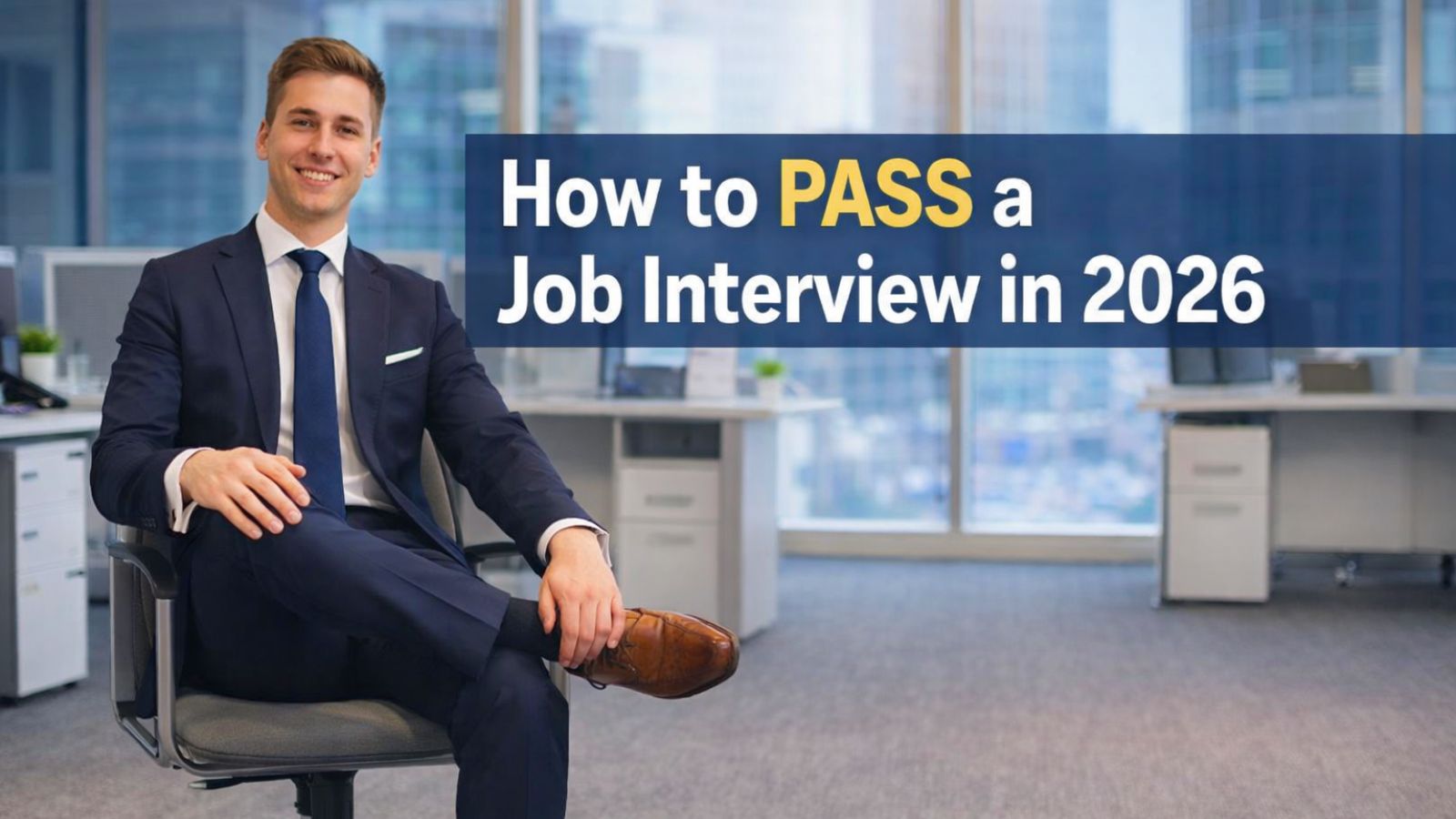
Just like AI is affecting the job market in 2026, it’s also changing how hiring actually happens. Therefore, your strategy for preparing for job interviews and how you answer questions should be updated to reflect this new reality.
Today, you are not just talking to a hiring manager. You are screened by AI, skill-based tests, and interviewers who care more about what you can do than what’s mentioned on your resume.
Whether you are graduating this year or looking to switch jobs soon, this guide will break down how to pass job interviews in 2026.
How Job Interviews Are Different in 2026?
The interview process isn't what it used to be. The hiring landscape has evolved, and you need to understand these changes to compete. Here are 3 big changes you must know about:
- AI-driven screening: In 2026, 82% companies use AI-powered ATS to filter resumes before a real person ever looks at them. These systems search for specific keywords and skills that match the job description. Some companies also use AI for one-way video interviews or as extra support for interviewers on the interview day. These AI tools analyze everything from your words to your facial expressions.
- Skills-first hiring over degrees: Companies care way more about what you can actually do than where you studied. Sure, having a college degree still helps in many fields, but employers in 2026 are increasingly looking at your actual skills. Tech companies led this trend, but it's spread to marketing, finance, healthcare, and pretty much every industry. 69.5% of recruiters prefer skills-based hiring now.
- Streamlined Processes: Many companies have realized that having a months-long hiring process is inefficient, and they might lose great candidates. In 2026, the trend is toward faster, more streamlined hiring. Many organizations now aim to make decisions within weeks instead of months. HR professionals using AI say they are able to hire about 52% faster.
Now, you know what changed, let’s understand how to implement it.
Your Interview Preparation Strategy
Before you think about passing the job interview, there is a lot to prepare. We have built a perfect job search strategy for 2026, but there are 5 specific tips you should focus on that can impress the interviewer when the day arrives.
1) Research the Company & Interviewers
If you have landed the interview, it’s time to dig a little deeper. Here are a few things you should definitely research about the company before you walk in:
- The company’s products or services
- Mission and values
- Recent news or launches
- Customers or target audience
- Tools they use
Start with the company's website, obviously. Here you will find most of the information about what the company does and its mission statements, and core values. From this information, you can understand who the customers of the company are.
But don't just read their "About Us" page and call it done. Look at their recent press releases, blog posts, and news mentions. Some companies also have their tech blogs where you can find out how to build their products.
Use ChatGPT or Claude to compile information about the company and extract insights. What you need to do now is to integrate all these insights into your interview answers.
When you talk about your skills or experience, connect them directly to the company’s goals, products, or a recent update naturally in your responses. This shows you didn’t just prepare for any interview, but you prepared for this one.
Also, if you know who's interviewing you (check your interview invitation email), look them up on LinkedIn. What's their background? What projects have they worked on? What do they post about? Finding common ground gives you natural conversation starters.
But remember that you don't want to be creepy about this research, though. Mentioning that you noticed they led an interesting project is professional. Referencing their Instagram post? That's crossing a line.
2) Include Projects & Certifications in Resume
We talked about skill-based hiring above and how it will become more and more important in the future. That means your resume should be front-loading with hands-on experience rather than just educational qualifications.
Your resume must have a separate Projects and Certifications section.
Companies are looking for people who have actually done something rather than just studied. So, building some projects for your portfolio matters more than ever. Projects show how you approach problems.
During interviews, projects also give you something concrete to talk about. Instead of giving generic answers, you can walk the interviewer through challenges you faced in your project.
Also, certifications are huge in 2026. They tell the company you have specific skills, and so, you can start contributing from day one without prior training.
If you have completed relevant online courses, include them too. Andrew Ng, co-founder of Coursera, also advised professionals to start taking AI courses specific to their industry.
3) Understand the Role
The job description tells you what the company is looking for, but you need to really understand what you'd be doing day-to-day.
Start by analyzing the job posting carefully. Read it more than once. Notice which skills are mentioned multiple times. Those are usually the ones the company cares about most.
Pay attention to what’s listed at the top of the description. Employers typically put their most critical requirements first.
If possible, take it a step further and find someone who currently does this job. You can look at LinkedIn or alumni networks. Ask them what they wish they had known before starting. These insights can help you tailor your preparation and answer interview questions in a way that feels informed.
4) Prepare Data-backed STAR stories
STAR stands for Situation, Task, Action, Result. It’s still the gold standard for answering behavioral interview questions. But in 2026, your stories need data and specific outcomes.

Prepare 5-7 strong STAR stories that cover different competencies:
- Leadership
- Problem-solving
- Teamwork
- Communication
- Adapting to change
- Dealing with failure
- Managing time
For each story, write out:
- Situation: Brief context (one or two sentences)
- Task: What you needed to accomplish
- Action: What YOU specifically did (this is the longest part)
- Result: What happened, with numbers/data when possible
For Example:
Practice these stories out loud. You don't need to memorize them word-for-word, but you should be comfortable telling them conversationally.
When using STAR, remember to add numbers (percentages, time saved, revenue impacted, users affected) to instantly make your experience more credible. Data turns your story from an opinion into evidence.
AI-assisted interviews used nowadays are designed to pick up on clear structure, relevant keywords, and measurable outcomes. STAR stories already provide a clean framework that helps both AI systems and human interviewers quickly understand your impact.
5) Practice with an AI Mock Interview
There are so many AI-powered mock interview tools available nowadays. These platforms simulate real interviews and give you feedback on your performance.
They ask you common questions for your field, record your responses, and analyze how clearly you communicate, whether you're using relevant keywords and skills, and even how confident you sound.
The best part about AI mock interviews is that you can practice anytime. They are especially helpful if you are too nervous to practice with real people initially.
Start with general questions to get comfortable, then move to industry-specific or role-specific questions. After the interview, pay attention to the feedback, take that seriously, and adjust.
All these practices and preparations will help you on the big interview day.
Tips to Pass a Job Interview in 2026
Now it's time for the actual work. Whether it's virtual or in-person, remember these 5 things to pass the job interview.
6) Go Through the Virtual Interview Checklist
Most interviews in 2026 happen over Zoom, Teams, or Google Meet, at least for the first round or two. Being good at virtual interviews is non-negotiable.
Virtual interviews have been common for years now, so employers expect you to have your setup sorted.
If you can’t prepare something as basic as your interview environment, they may assume you will bring the same lack of preparation to the job.
A Cornell University study found that even small video-call glitches can negatively affect whether candidates pass job interviews or not.
Here is the checklist you need to follow:
- Open The Website/App and check if you are logged in (if required).
- Double-check the meeting link
- Make sure the correct mic and camera are selected
- Close all unnecessary tabs on your laptop and browser
- Open the additional websites and tools required for the interview
- Check that your display name shows your real name, not a nickname
- Make sure your laptop is fully charged or plugged in
- Turn off laptop and phone notifications
- Reopen the email again to check if you are not missing anything
- Join the meeting 3–5 minutes early and take a breath
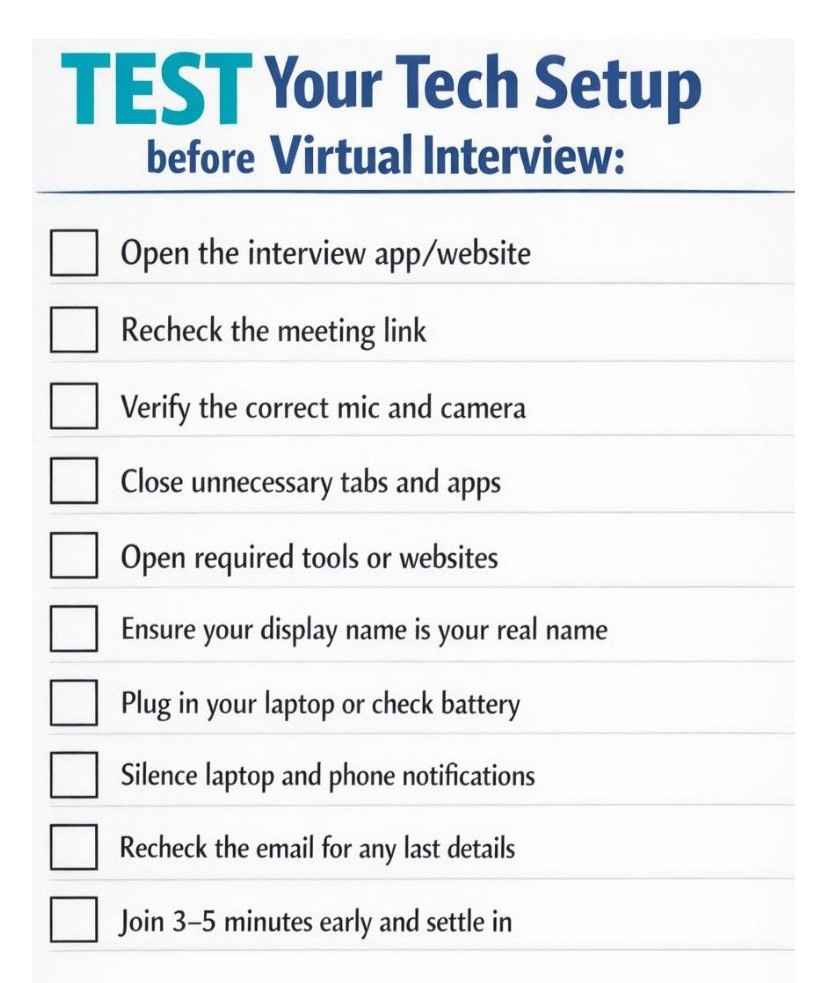
Test your setup at least 15 minutes before your interview. You also need good lighting and a noise-free space.
Keep your resume, your notes, and your STAR stories nearby. You can reference them during the interview without the interviewer knowing. This is one advantage of virtual interviews. There are many more tips in our virtual interview guide.
Do a practice run with a friend beforehand to make sure everything looks and sounds good from their end.
7) Be on time & Dress like a professional
For in-person interviews, arrive 30 minutes early. So, plan your route, check traffic or public transit delays, and build in buffer time. For virtual interviews, log in 2-3 minutes early. Those 2-3 minutes show you are punctual.
If something unexpected happens and you will be late, call immediately, like as soon as you know, not when you're already late.
Dress appropriately, just like the employees in that company do.
Research the company culture to decide whether you have to go full formal or business casual will work. When in doubt, go slightly more formal than you think necessary. It's better to be overdressed than underdressed.
Even for virtual interviews, dress professionally from head to toe. This puts you in the right mindset.
Also, for in-person interviews, pay attention to details like polished shoes, neat hair, minimal jewelry, and go easy on cologne or perfume. Make sure your clothes fit well and are wrinkle-free.
This is really your actual first impression on the interviewer. It signals that you take this seriously.
8) Use short answers
Since interviewers want to hire faster these days, rambling is an immediate red flag. They have very little time to decide, and even a small mistake like this will make your resume go in the trash.
Aim for answers that are 1-2 minutes long for most questions.
The STAR-structure stories you practiced will help here.
Avoid filler words like "um," "like," "you know," and "basically." Pausing briefly while you think is much better than filling the silence with these verbal crutches.
Interviewers often speak to multiple candidates in a day, and long, messy answers make it harder for them to understand your point.
When you keep your responses concise, you make their job easier and your message clearer. It shows that you can think clearly and prioritize important details.
Most importantly, short answers keep the conversation flowing. They leave room for follow-up questions and discussion, which makes the interview feel more natural.
9) Explain your thinking, not just the final answer
While it’s important to give short answers, you still have to explain what you are thinking for technical questions or case interviews.
Employers aren't just interested in what you did, but they want to understand how you think.
When answering questions about past projects or challenges, walk the interviewer through your thought process:
- What information did you gather?
- What options did you consider?
- How did you make your decision?
- What trade-offs did you evaluate?
This way, you show how you approach problems and make decisions. That’s often more important than the answer itself.
It also builds trust. If interviewers understand your logic, they can see that you’re not memorizing answers but you are thinking in real time. Even if your final answer isn’t perfect, a solid thought process can still leave a strong impression.
10) Show Confidence, Enthusiasm & Learnability
Here's the final piece of advice. There are 3 things that you must keep in mind when answering interview questions: Confidence, Enthusiasm, and Learnability.
Skills might get you in the door, but personality gets you hired.
- Confidence: Believe in your abilities and communicate them clearly. Make eye contact, speak at a good volume, and own your accomplishments. But avoid bragging or putting others down to make yourself look good.
- Enthusiasm: Show genuine enthusiasm for this company and this role. What interests you about what they do? What excites you about the position? Also, connect your passion to their mission.
- Learnability: Learnability might be the biggest soft skill in 2026. Workflows change rapidly, and companies want someone who can understand the new AI tools as quickly as possible. When you show that you can learn quickly, adapt, and improve, you become a safer long-term hire.
Together, these 3 signals tell employers that you are capable now and ready for what’s next.
Conclusion
Passing a job interview in 2026 isn't just about understanding the modern hiring landscape. The process has changed a lot, but the fundamentals like preparation and clear communication still matter.
Remember, the companies interviewing you are looking for someone who can do the job well. Your goal is to show them you are that person.
Start with deep research on the company and the role. Update your resume to showcase skills and accomplishments. Prepare STAR stories with measurable results. Practice with AI mock interviews.
Then pass the interview itself with a professional presentation, concise answers, clear thinking, and authentic engagement.
Table of Contents
Related articles

US Mass Layoffs Spike in 2025 as Goldman Sachs Flags a Weakening Job Market
US layoffs have surged to their highest level since 2016, with Goldman Sachs warning of growing weakness in the job market.

Opendoor's New Chairman Wants to Fire 85% of Workers, Calls Company "Completely Bloated"
Opendoor’s new chairman Keith Rabois says the company is “bloated,” wants to cut 85% of jobs, and blames remote work for a broken culture.
Young Software Developers Losing Jobs to AI, Stanford Study Confirms
Stanford researchers analyzed millions of workers and found developers aged 22-25 lost nearly 20% of jobs since ChatGPT launched while older programmers kept getting hired as companies replace entry-level coding with AI.

4 Industries That Are Least Affected by AI in 2025
Here are 4 sectors where job postings are actually increasing in 2025 and why they are attracting new talent.

Fed Chair Powell Says Young Workers Having 'Hard Time Finding Jobs'
Powell says young workers are struggling most in today’s weak job market, with hiring slowing from 150,000 to just 29,000 a month. AI may be a factor, but its impact is unclear.
