10 Salary Negotiation Tips That Work in 2026


.avif "Kaivan Dave")

Talking about money is awkward, whether it’s your first time negotiating a salary or looking for a promotion. But money is important, and you should get the best deal for your financial future.
According to a 2026 salary guide, most candidates feel confident they can negotiate their salary this year. But on the other side, 74% of managers say they are struggling to keep up with employee expectations.
His gap shows a clear mismatch: employees believe they have strong leverage in today’s job market, while managers are dealing with pressure to control costs. That’s the key reason behind massive layoffs last year.
That led to only 31% employees negotiating their offers for freshers, less than the previous year. But salary discussion is something you must do.
This is a guide on 10 salary negotiation tips for the changing job market of 2026.
10 Salary Negotiation Tips for 2026
Remember, in business, you don’t get what you deserve; you get what you negotiate. This principle highlights that hoping for fair pay isn’t enough, but you must actively advocate for your value.
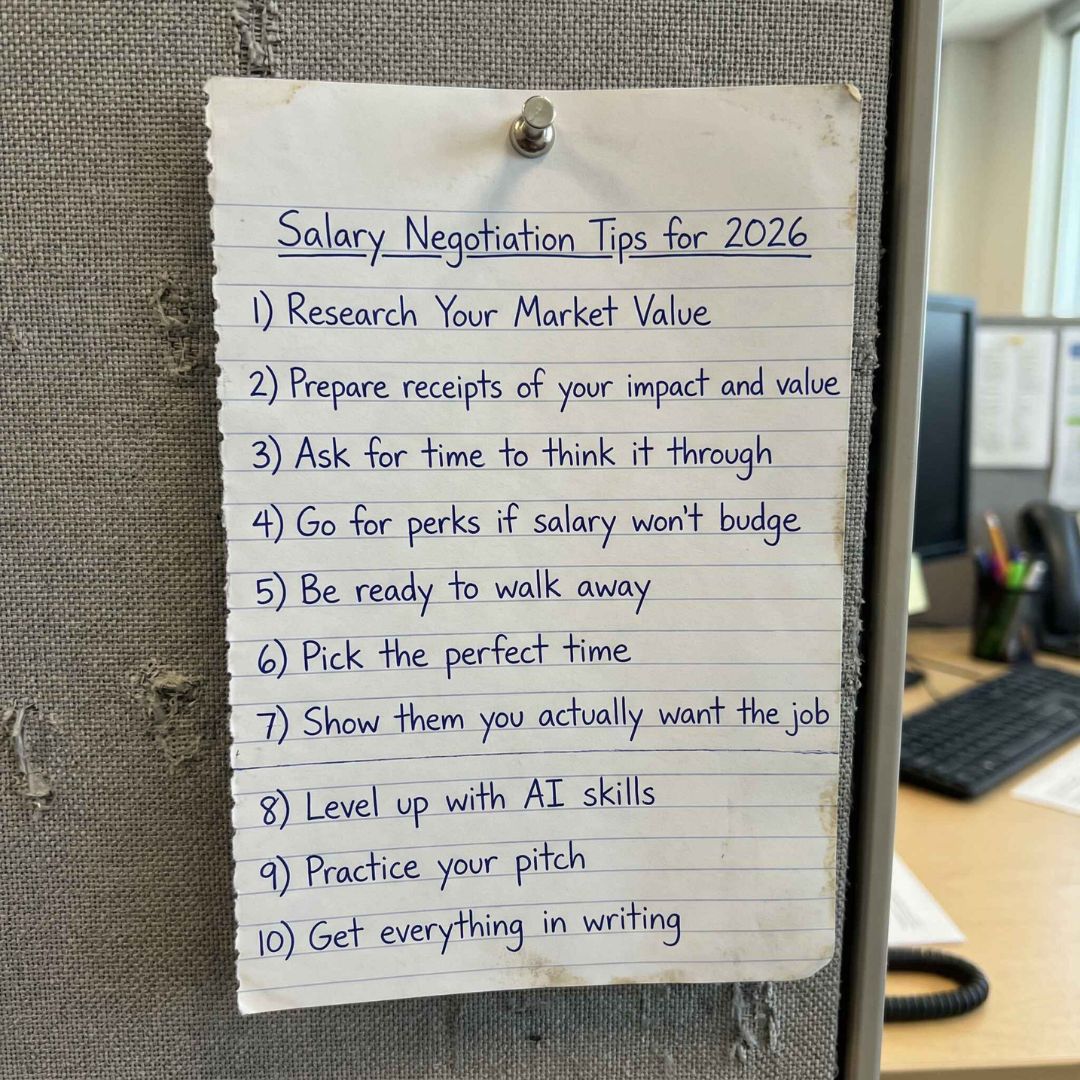
Here are the top tips to get a better offer in 2026:
1) Research Your Market Value
Before you even think about throwing out a number, you need to know what you are working with. You need to know what you are actually worth in the current job market.
After Stephen A. Smith signed a new contract, he shared some advice for other professionals:
"The numbers are always arguable, [but the goal is to have a] ballpark idea of what those numbers are and what your worth is, and by virtue of that, when they come to you, you're able to negotiate."
Going in with a clear salary range also shows you have done your research and makes it easier to respond confidently when the employer pushes back.
Start with websites like Glassdoor, Payscale, and Salary.com. These platforms let you filter by job title, location, years of experience, and even company size. Look for the specific job role you are applying for or working for, with similar experience, in your city.
In 2026, you will have more AI-powered salary calculators and tools than ever to figure out what people in your position actually make.
You can even look inside Reddit threads where people are surprisingly transparent about their compensation.
At last, reach out to people in your network who have similar roles. Most people are happy to help, especially if you are not asking them to share their exact salary.
Here are all the places to research:
- Salary comparison websites
- Job listings
- Industry reports
- Online communities like Reddit, Discord, etc.
- Professional network
The goal here isn't to find one perfect number. You want to find a range, and what's the high end? Having this range in mind before you start negotiating is crucial.
Know your worth first and believe it.
2) Prepare receipts of your impact and value
Companies pay you for the value you create. So when it's time to negotiate, you need to prove you deserve every dollar you are asking for. This means having concrete examples ready to go.
Think about your biggest wins:
- Did you increase sales or revenue?
- Save the company money?
- Launch a successful project on time?
- Improve a process that was driving everyone crazy?
- Improve a process that was slowing everyone down?
- Automate or streamline repetitive work?
- Mentor teammates or help onboard new hires?
Basically, did you deliver results that directly supported business goals?
Write these wins down with actual numbers attached. For example, instead of saying "I improved our social media presence," say "I grew our Instagram following from 5,000 to 50,000 followers in six months, which generated 200 qualified leads."
Gather all the evidence.
Prepare a small presentation on all the projects you completed in the last 6-12 months, with quantifiable results, and the positive feedback you received from your boss or your client/customer.
Also, if you were one of the first people at your company to introduce them into everyday workflows and help others learn them too, that’s a huge win when negotiating your salary in 2026.
During the negotiation, you will reference all these to back up your expectation.
3) Ask for time to think it through
A US Survey found that 55% of employees accepted their job salary offer without any negotiation. But that is not recommended.
When a company makes you an offer, you don't have to answer on the spot. Ask them to give you time of about 1 to 2 days to think it thoroughly.
Why does this matter? Because it gives you time to analyze the offer and prepare your counteroffer if you decide to negotiate.
Any reasonable employer will respect this. They understand that this is a major decision in your life. It also signals that you take such things seriously, and you will put this much extra care into their business, too.
But if you still feel like it is a risk or you may sound rude, Mandi Woodruff-Santos, a career expert in New York City, shared an important advice:
“I think it’s really important to ask for time to review their offer and then ask for a phone call, and then counteroffer or discuss the compensation. If you’ve gotten to that stage already, they clearly want to work with you, and it will take a lot of trouble for them to go back to the drawing board and find another candidate.”
Remember that once a company makes you an offer, you already have leverage.
They have invested time in interviews and paperwork because they want you. Replacing you would mean starting the hiring process all over again, costing them more time and money.
4) Go for perks if salary won't budge
Sometimes your boss legitimately can't move on salary because of strict pay bands, budget constraints, or internal equity issues.
But as you know, salary is just one piece of your total package, and there are other valuable perks and benefits you can negotiate:
- Signing bonus: This is often the easiest thing for companies to approve because it's a one-time expense, not a recurring cost.
- Student loan repayment assistance: Some companies offer programs where they will contribute toward paying off your student loans.
- Extra paid leave: With burnout being such a huge issue, vacation time is incredibly valuable. If you can negotiate for 2 to 3 weeks of holidays, that's basically like getting paid for an extra week.
- Remote work flexibility: If the role is hybrid or in-office, see if you can negotiate more work-from-home days. With remote work becoming more normalized over the last 5 years, companies are often open to this.
- Home office stipend: If you are remote, ask if they will cover better equipment, a monitor, an ergonomic chair, or give you a monthly stipend for internet and phone bills.
- Stock options: If you are joining a startup, equity could end up being worth way more than a higher salary.
A recent survey shows 75% of employees value flexible hours, 62% want remote work, and 48% want extra holiday time.
The key is to think about what would actually improve your life and make the offer more attractive.
5) Be ready to walk away
This might be the hardest tip on this list, but it's also one of the most important. Be Ready to say NO if the offer doesn’t meet your minimum requirement.
You have already figured out the expected salary range you deserve. The lower number is your breakout point.
Walking away feels scary, especially if you need a job. But accepting an offer that doesn't meet your needs will only leave you financially stressed and resentful for the coming months.
Sometimes companies will come back with a better offer after you have declined. When you are willing to walk away, it shows you know your value.
But if they don’t, leave the negotiation.
6) Pick the perfect time
Timing in salary negotiation is everything. Ask too early or wait too long, and you lose leverage.
Our survey with US recruiters found that the best time to ask for a raise is right after you have completed a major project or delivered a clear win for the company. 67% of managers say that timing is very critical.
For a fresher, the best time to negotiate salary is after you have received a formal job offer, not before.
Once the company makes an offer, it’s a clear signal that they want you and are willing to invest in you. At this stage, you can take time to review the offer and discuss pay without risking the opportunity.
And avoid bringing up salary during moments when the interviewer is focused on evaluating your skills or fit. If you are in the middle of a technical interview or meeting with your potential team members, that's not the time to ask about money.
7) Show them you actually want the job
The best negotiations happen when the company knows you are genuinely excited to work there.
Why does this matter? Because negotiations can feel bitter if you are not careful. If you come in focusing only on what you want without showing what you are excited to give, it can rub people the wrong way.
So, mention specific things about the company or role that excite you. Maybe it's the mission, the team, the technology stack, the growth opportunities, or the company culture.
8) Level up with AI skills
Welcome to 2026, where AI literacy is becoming as essential. If you want to increase your worth in weeks, this is the easiest way.
As you know by now, AI isn't going away, and companies are actively looking for people who can use these tools to work faster.
Since this is a big trend right now and employers want more productive people, adding some AI skills to the conversation will only help.
Andrew Ng, co-founder of Coursera, advises tech professionals to take a few relevant courses on AI. Start from the basics and learn structurally to understand concepts thoroughly to apply them with ease, or find new ways to use the new tools.
The best thing is that you can learn most of the AI tools made for your industry in just a couple of weeks.
This gives you some more leverage by showing that you are putting more effort into the job and will produce more results for the company.
Also, follow AI news and trends so you can speak knowledgeably about how these technologies impact your industry.
A study found that AI skills are associated with a roughly 23% wage premium, meaning workers with demonstrable AI expertise tend to earn significantly more than those without.
9) Practice your pitch
Practice your negotiation pitch until it sounds natural and confident.
Start by writing out your key talking points, like the market research you did, projects you completed, and what salary & perks you are looking for.
Then practice saying it out loud. Say your pitch 10 times. 20 times. However many times it takes until you can deliver it smoothly without reading from notes.
Practice in front of a mirror so you can see your body language. Are you making eye contact? Are you sitting up straight? Do you look confident or nervous? Your non-verbal communication matters as much as your words.
The goal is to become so comfortable with your main points that you can have a natural conversation while hitting all the important beats.
10) Get everything in writing
After you get the better pay, but before you are ready to complete the conversation, ask that you need the offer in writing.
Verbal agreements and handshake deals don't count, especially for perks. You need an official written offer letter that spells out exactly what you have agreed to.
Your offer letter should include:
- Base salary
- Start date
- Job title.
- Bonuses and incentives
- Equity or stock options
- Benefits
- PTO and vacation
- Remote work arrangements
When you receive the offer letter, read every single line carefully. Check that every number is correct, every benefit you discussed is included, and there aren't any surprise clauses.
Conclusion
Remember, salary negotiation isn't about being pushy or demanding. It is just a conversation between two parties trying to reach an agreement that works for everyone.
The biggest mistake you can make is not negotiating at all. Companies expect it. In fact, many hiring managers build room into their offers specifically because they know candidates will negotiate. If you don't ask, you're literally leaving money on the table.
Table of Contents
Related articles

Revolutionize Your Job Interview Process: How AI Helps in 2024
Are you ready to change your hiring process and stay ahead in the job market? Artificial Intelligence (AI) is changing recruitment with new solutions. It helps with screening candidates and doing initial interviews, changing how companies find and check talent.

Target Interview Process & Hiring Guide
Get a complete guide to the Target interview process, hiring stages, common questions, and tips to help you prepare and stand out.

Sample Interview Questions: Ace Your Next Job Talk
Job interviews can be very stressful. They usually last 45-60 minutes and you face a panel of 3 to 12 people. That's why getting ready for an interview is key to doing well. Let's look at why it's important and how it can make you feel more confident.

Ace Your Practice Interviews: Tips for Success
Let's explore the world of interview prep and find out how to stand out. With the right tips, you'll feel confident and ready for any interview.

Ace Your Behavioral Interviews: Key Preparation Tips
Did you know 92% of Fortune 500 companies use behavioral interviews? This shows how crucial it is to learn interview preparation strategies for these tough tests. We're here to help you get ready to show your best.