No Degree Needed for These 18 Top-Paying Jobs


.avif "Kaivan Dave")

When even white-collar jobs don’t feel safe in 2026 because of AI and robots coming for blue-collar work too, it’s starting to feel like we need to rethink where stability comes from.
Maybe that means finding new opportunities or even revisiting some old ones to build a more secure future.
Young people, and even those looking to escape a frustrating work life, are now searching for top-paying jobs in the US that don’t require a college degree to live comfortably in 2026. So, here’s the list.
18 Top-Paying Jobs in the US Without a Degree
College is expensive. Like, really expensive. The average student loan debt in the USA sits around $37,000 for more than 43 million students.
Not everyone wants to start their adult life buried in debt, especially when there's no guarantee that a degree will lead to a job. And for some, it’s not just money, but time as well. Four years is a long time.
And we need to remember that not everyone is a classroom nerd. Some are good at hands-on professionals, fixing or building things.
As people are becoming more conscious about their life choices, they look for a career beyond a formal education.
That’s why the professions mentioned in this list are becoming popular in 2026.
Here are the high-paying jobs where a degree is not needed:
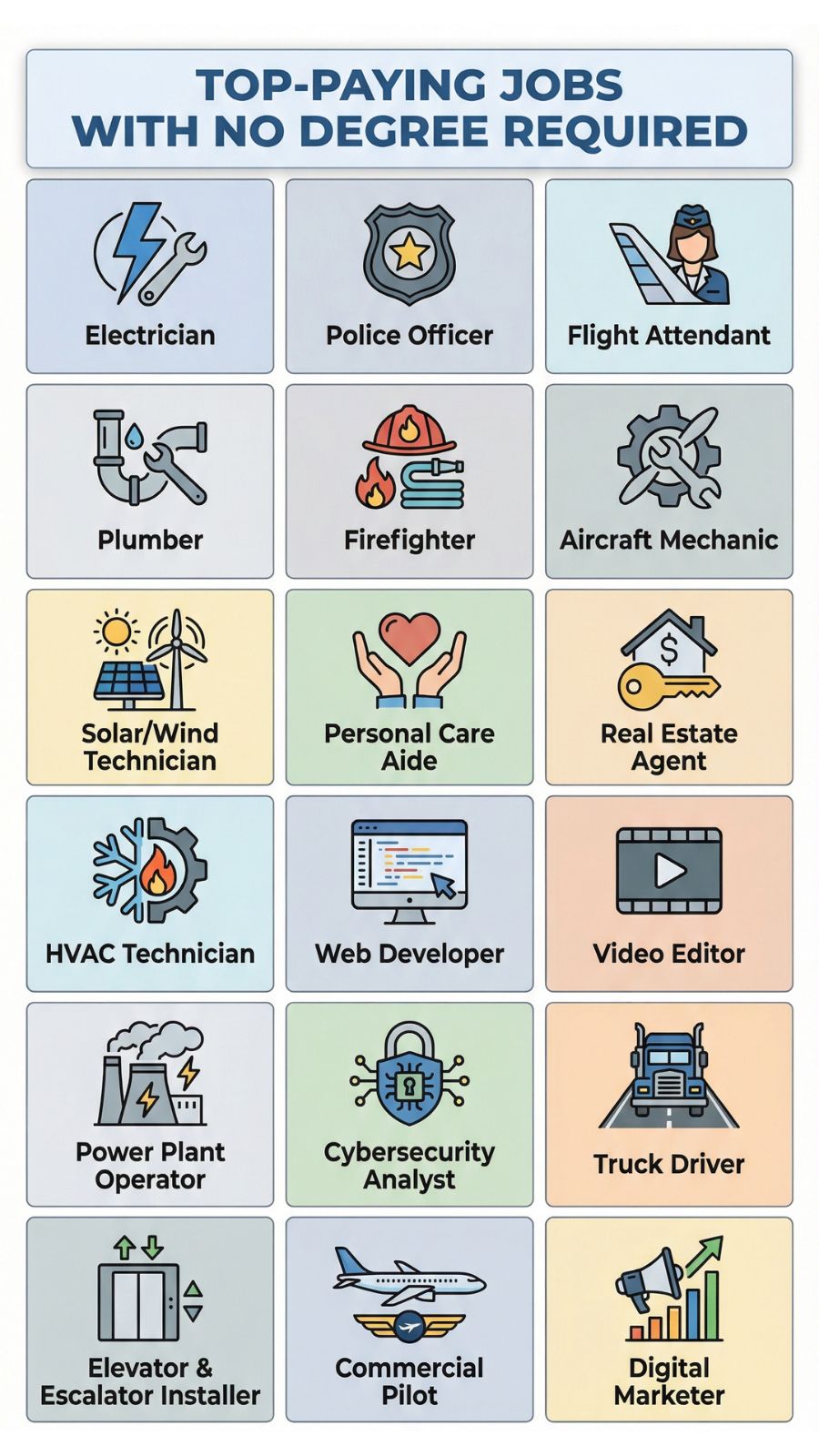
Let’s discuss each to understand why this job will give you a great career and how to start your journey. All the data about pay is taken from the USA’s Bureau of Labor Statistics.
1) Electrician
Average Pay: $62,000
Becoming an electrician in the USA doesn’t require a traditional college degree. You may go to a technical school program for training after or spend a few years in apprenticeships with hands-on training.
You can start earning $50-60K from the first year, and with experience, making well over $100,000 is also possible when you become a master electrician.
Climate activist Bill McKibben said in a podcast that an electrician is a future-proof career:
“In America, we're going to need a million or two million more electricians in the next decade to get this job done. No electricians that I know of are hurting for work at all. It's a well-paid job that's now doing one of the most important tasks on the planet, electrifying the earth so that we don't have to destroy it. So that's the closest thing to straight-on advice I've got for anyone.”
The demand is actually also going to increase. There is new construction coming up, renewable energy is also a huge market, electric vehicles, and data centers.
Data centers to power all the AI models coming up will spike the demand in the US, because these facilities are insanely power-hungry. Companies like Amazon Web Services, Google, and Microsoft are pouring billions into massive data centers. You now have a chance to become part of the AI revolution.
2) Plumbers
Average Pay: $62,000
Just like Electricians, Plumbers are needed too.
Plumbing is also learnt through apprenticeships lasting 4-5 years, combining paid work with classroom training. During your apprenticeship, you will learn pipe systems, water supply, drainage, fixture installation, and local building codes.
New construction and new data centers will also need to manage the water flows just like the electricity. Installing pipelines, fixing and maintaining them is a task that not everyone can do.
That’s why there's a significant shortage of skilled tradespeople, including plumbers. At the 2026 World Economic Forum, NVIDIA CEO Jensen Huang said:
“It's wonderful that the jobs are related to tradecraft and we're going to have plumbers and electricians and construction and steelworkers.”
These Skilled trades are back in high demand due to massive infrastructure growth in data centers.
And remember, Plumbing can’t be automated or offshored. It also remains essential for buildings and infrastructure, just like electricity. They are the best AI-proof careers today for people who don’t want to go to university.
3) Solar/Wind Technicians
Average Pay: $62,000
Just like data centers, we are seeing a shift towards renewable energies, and if you know how to install solar panels or fix a wind turbine, you can earn good money.
Most solar and wind technicians have certificates or associate degrees from technical schools, but four-year degrees aren't required. Training programs typically last 6 months to 2 years.
Renewable energy is one of the fastest-growing sectors in the country. Federal and state incentives are driving massive investments in solar and wind projects. As the USA transitions toward cleaner energy, demand for qualified technicians will only increase.
The lack of skilled workers is actually becoming a major bottleneck. In fact, 76% of energy employers report having difficulty hiring, highlighting a growing gap between job demand and the availability of trained professionals.
It also requires a lot of physical work and working in difficult outdoor conditions, so robots can’t snatch your job anytime soon.
4) HVAC Technician
Average Pay: $59,000
HVAC technicians earn an average of $50,000, with experienced ones earning more than $80,000. They typically complete training programs at trade schools and then work as apprentices. EPA certification is required for handling refrigerants.
The future is also strong. Everyone needs heating and cooling. It's not optional in most of the USA. Climate change is making summers hotter and winters more unpredictable, increasing demand for HVAC services.
Each year, about 25,000 HVAC technicians leave the workforce (due to retirement mostly), and there aren’t enough new entrants to replace them.
On top of that, the push for energy-efficient buildings and stricter environmental regulations keeps demand high, which helps drive salaries up even further.
5) Power Plant Operators
Average Pay: $103,000
Power Plant Operator is one of those jobs that pays well because it requires technical knowledge and carries significant responsibility.
Most operators enter with a high school diploma and receive extensive on-the-job training. Some positions prefer candidates with technical training from community colleges, but a four-year degree isn't necessary.
As we know, traditional power plants are aging, and many operators are retiring, creating openings. While overall demand isn’t growing fast due to automation and shifting toward renewable energy sources, there’s still a steady replacement demand.
6) Elevator & Escalator Installer
Average Pay: $106,000
If you know how to install or repair elevators (or escalators), you can earn more than $100K. It's one of the highest-paying trade jobs available, and no degree is required.
To begin a career in this domain, it typically requires completion of an apprenticeship program, which combines paid on-the-job training with classroom instruction.
Because elevators and escalators are everywhere, from offices, apartments, malls, hospitals, and so on, you will always be needed for regular maintenance.
7) Police
Average Pay: $77,000
Police is a solid career choice in the USA. Officers in major cities or specialized units can earn up to $100,000 as well, especially with overtime. Benefits packages are typically excellent, including pensions, health insurance, and paid time off.
The best part is that a 4-year degree is not needed. Most police departments require only a high school diploma.
Many departments are actively struggling to recruit new officers due to the job’s stress and public scrutiny, which actually creates more openings year after year. A survey found that over 70% of law enforcement agencies say recruiting new officers is harder now.
While discussing steep drops in applicants, NYPD Commissioner Jessica Tisch said:
“We need more cops, and I’m not going to sugarcoat it. The NYPD is in a hiring crisis.”
While policing isn’t among the highest-paying trades, job security is strong if you are comfortable with the realities of the work.
8) Firefighters
Average Pay: $59,000
Firefighters earn an average of $50,000-$60,000, but salaries vary widely by location and department size. Add in excellent health insurance, pensions, and total compensation is quite good.
Most fire departments require only a high school diploma. However, having an EMT certification or fire science coursework from a community college makes you much more competitive.
The demand is also stable. Modern firefighters do more than fight fires. There are medical emergencies, hazmat situations, rescue operations, and community education that are all part of the job.
The future for firefighters also looks good because cities are growing and climate change is increasing the number of wildfires as well as extreme weather events. At the same time, many older firefighters are retiring, which creates steady job openings across the country.
Firefighting is also recession-proof because emergencies don’t stop when the economy slows down, and communities always need trained professionals to keep people safe. So, job security is a key factor here.
9) Personal Care Aides
Average Pay: $35,000
While it doesn’t fit the "top-paying" category, the work is peaceful if you are looking for a switch to a simple career.
First of all, no degree required. Most states require completing a training program and passing a competency exam to become certified. Some positions require only on-the-job training.
But the demand is massive, and barriers to entry are low. America's aging population (baby boomers) is driving explosive demand for home health aides. Between 2024 and 2034, the U.S. is projected to see around 9.7 million total job openings in direct care roles.
For those seeking meaningful work helping others, with flexible hours and plentiful job opportunities, it's a viable option. And since this job need personal touch, AI can’t replace it at all.
10) Web Developer
Average Pay: $95,000
Now, let’s talk about white-collar jobs, and honestly, one of the biggest breakout opportunities over the last few years has been becoming a web developer.
Unlike hardcore software engineering roles, where big tech companies almost always want a formal degree, web development is way more flexible. Many successful web developers are self-taught.
A lot of web dev work isn’t about building insanely complex systems. It’s about creating clean, functional websites that just work, which means skills often matter more than certificates.
And yes, AI can now spin up a website in minutes, but that doesn’t mean web developers are suddenly obsolete. Small businesses still need someone to set things up properly for e-commerce or service sites. AI might do the heavy lifting faster, but there’s still a very real demand for web devs.
11) Cybersecurity Analysts
Average Pay: $124,000
Cybersecurity is one of the top-paying jobs in the US, and the future looks great.
Cybersecurity roles often pay well above average because companies are protecting critical data, and mistakes can be very costly.
The bigger issue is that every industry needs cybersecurity now, from banks and hospitals to governments and tech companies, and there simply aren’t enough skilled professionals to fill all the roles.
Matthew Walsh, Research Director at Lightcast, said to WEF in 2025:
“Despite broader economic uncertainty, demand for cybersecurity talent remains high, with a workforce gap continuing to challenge both the public and private sectors.”
Many people enter the field without a four-year degree by earning certifications and gaining hands-on skills. Certifications like CompTIA Security+, Certified Ethical Hacker (CEH), or CISSP carry serious weight in the industry. So, a formal university education is not required.
Also, Cybersecurity is a skill that even AI can’t replace because it requires human creativity and understanding hacker behavior, which no LLM can fully anticipate.
On top of that, hiring is a big issue. A survey show 65% of organizations still have unfilled cybersecurity roles, proving demand is much higher than supply.
12) Commercial Pilots
Average Pay: $198,000
Commercial pilot is one of the highest-paying jobs in 2026 that doesn’t require a traditional 4-year college degree.
But training is a big requirement here. To become a pilot, you need proper flight training and licenses. It will cost a lot, but the pay is also high.
Flying passengers or cargo comes with huge responsibility, safety pressure, and strict regulations, and companies are willing to pay well for experienced pilots they can trust.
The future also looks very strong because the US is facing a pilot shortage as older pilots retire and air travel demand keeps growing, including cargo flights, private jets, and regional airlines.
According to the Boeing Pilot and Technician Outlook, the industry will need around 660,000 newly qualified pilots, 710,000 new aircraft maintenance technicians, and nearly 1 million cabin crew members over the next 20 years
13) Flight Attendant
Average Pay: $67,000
Now, let’s come to the crew. If you don’t want to fly the plane but be a part of the aviation industry, become a Flight Attendant.
Airlines focus more on safety training, customer handling skills, and certifications than formal education, so most flight attendants qualify with a high school diploma and airline-provided training approved by federal aviation authorities.
Pay starts moderate, but it grows steadily with seniority. On top of salary, the benefits are a huge plus, including free or discounted travel.
The future outlook is also solid because air travel keeps growing and airlines are expanding routes. Even when the economy slows down, airlines still need cabin crew for safety compliance, not just service, which makes the role more stable than people expect.
14) Aircraft Mechanics
Average Pay: $79,000
Aircraft mechanics, also called aircraft maintenance technicians, are a good career choice in the aviation sector.
To work legally, mechanics must be certified by the FAA, which already involves strict testing and real-world training, so employers trust licensed technicians.
Like other industries, many experienced mechanics are retiring, creating shortages. So, you can easily find a job here if you have the skills.
15) Real Estate Agent
Average Pay: $58,000
Becoming a real estate agent in the USA is one of those careers that sounds way more complicated than it actually is. But what we need to know the most is that you don’t even need a college degree to get started. No four-year commitment.
All you need to do is complete a state-approved real estate licensing course and then pass a licensing exam. That’s it. For most people, this entire process takes just a few months, not years.
Now let’s talk money. Your income as a real estate agent depends heavily on where you work and how active the market is. In many states, agents start around $50K a year. But once you gain experience, it’s very common for agents to cross $100K or more, purely through commissions.
And the biggest reason real estate is such a powerful career choice is that housing never stops. Even when the economy slows down, people still need places to live. They still buy, sell, and rent homes.
Also, you are helping people through major life moments, and that makes it a highly satisfying job.
16) Video Editor
Average Pay: $70,000
Video editing is honestly one of the best creative careers right now, and the best part? No film school. No expensive certifications.
Most successful video editors learn everything through YouTube tutorials, online courses, and hands-on practice. You learn by doing, editing real projects, experimenting, and improving with every video.
And here’s why video editing is such a big deal in today’s world: Everyone needs video content. Businesses need ads. YouTubers need weekly uploads. Brands need social media videos. Podcasts need clips. Influencers need daily content. Media companies need editors around the clock.
17) Truck Driver
Average Pay: $57,000
Commercial truck driving is one of those careers that quietly keeps the entire US economy running. That demand isn’t slowing down anytime soon. And you don’t need a college degree to get started.
To become a truck driver, all you need is a Commercial Driver’s License (CDL). Most people earn their CDL in a few weeks to a few months, depending on the training program. That’s a super short runway compared to traditional careers that take years.
There’s also a major driver shortage. A large portion of the current workforce is nearing retirement, and not enough younger drivers are entering the field. Forecasts project a shortfall of around 174,000 drivers by the end of 2026. That imbalance keeps wages strong and job security high.
18) Digital Marketer
Average Pay: $129,000
Digital marketing is honestly one of the easiest white-collar careers to break into in the US without a college degree. No four-year program. No massive tuition fees.
A huge number of digital marketers are self-taught, or they learn through online courses and real-world practice.
So what do digital marketers actually do? They help businesses grow online. That can mean running ads on Google or social media, managing Instagram and TikTok accounts, improving Google search rankings, writing marketing emails, or making content.
And as the world becomes digital, every company today needs an online presence. Small businesses to big brands. That’s why demand for digital marketing skills is everywhere.
Another big advantage? Flexibility. Many digital marketing roles are remote, freelance, or contract-based. That means more control over your schedule.
Conclusion
Now, you have all the options. As you see, opportunities exist without going to a university where practical skills, certifications, and on-the-job training matter more than diplomas.
All you need is the willingness to learn and develop actual skills. So, start your research. Find out more about careers that interest you. Consider your strengths. High pay is great, but if you hate the work, you won't stick with it.
Now stop reading and start the research.
Table of Contents
Related articles

C3.ai Cuts 26% Workforce in Major AI Industry Reset
C3.ai is laying off about 26% of its workforce after a major leadership change. So, why does it matter, and what does it reveal about the real state of the AI industry?

44% of Young Americans Fear AI Will Shrink Job Opportunities
A new Harvard Youth Poll shows 44% of young Americans worry AI will reduce job opportunities. Learn what students think about AI’s impact on careers.

Which Skills Are Most in Demand Amid Layoffs in 2025
While tech layoffs make headlines, some skills are more in-demand than ever. Discover which skillsets companies are desperately seeking in 2025 and whether you're on the list?

15 Highest Paying AI Jobs in 2025 and Why Demand Is Exploding
While tech layoffs make headlines, AI professionals are getting $200K-$900K offers. Check out top-paying AI careers in 2025, from AI Research Scientists to AI Product Managers, plus why demand is exploding.