US Not Ready for AI Job Shock Warns Nobel Prize Winner


.avif "Kaivan Dave")
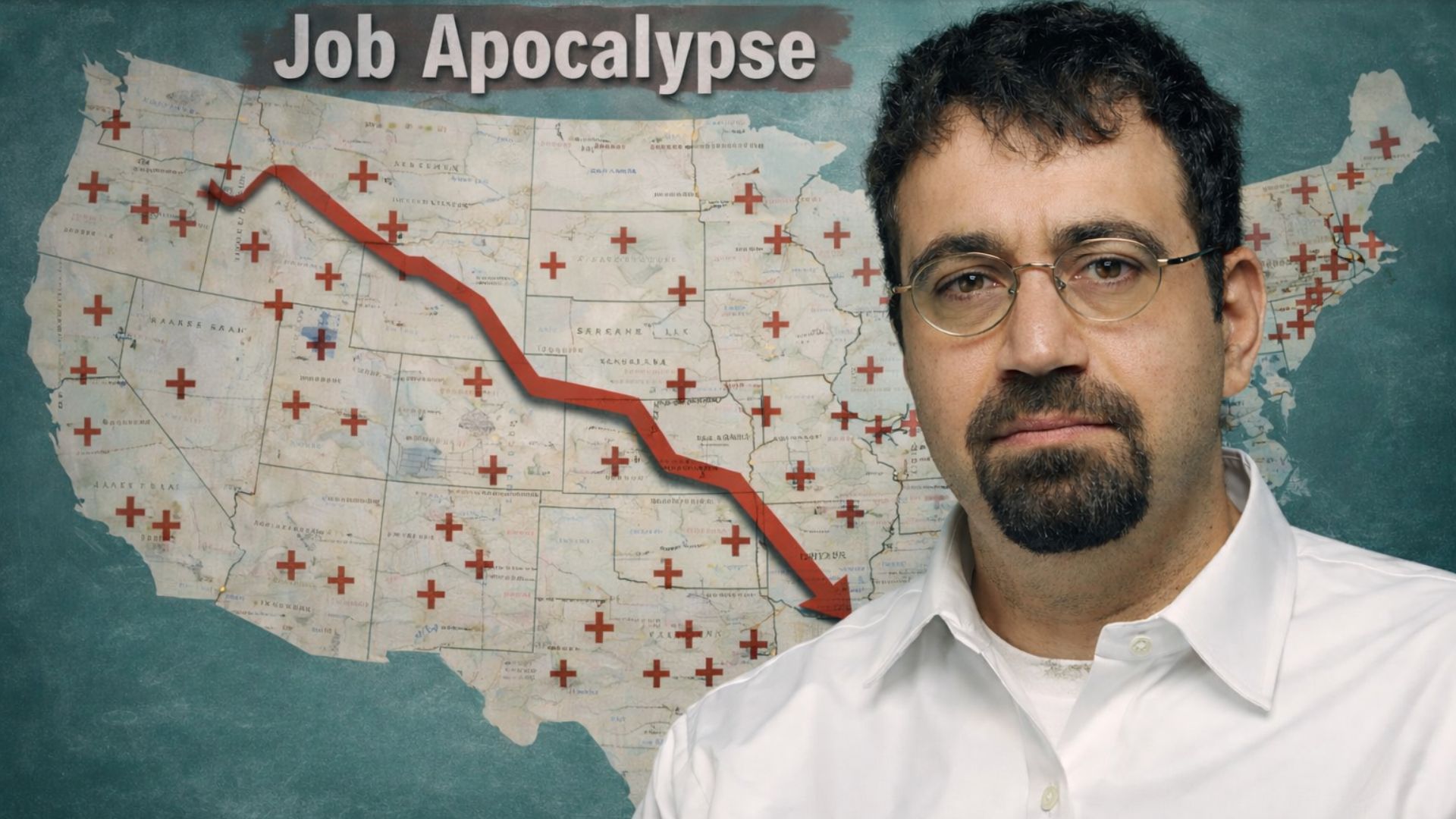
A world-renowned economist who predicted nations’ failures now says AI threatens the foundation of American democracy. The warning signs are already here.
Daron Acemoglu on AI Job Disruption
Imagine walking into work tomorrow and finding out a computer program will be doing your job. Not in ten years. Not eventually. Tomorrow. For millions of Americans, that nightmare is becoming reality.
Daron Acemoglu, the MIT economist who won the 2024 Nobel Prize for his groundbreaking work on why nations succeed or fail, delivered a stark warning:
“If we go down this path of destroying jobs [and] creating more inequality, U.S. democracy is not going to survive.”
Daron Acemoglu’s opinion matters because he isn’t just another commentator reacting to headlines. He is one of the most respected economists in the world.
He has written extensively about how institutions, policies, and incentives determine whether technology helps ordinary people or concentrates power at the top.
That’s important right now because AI is moving incredibly fast, and the rules around it are still being written.
Acemoglu doesn’t argue that technology is bad. Instead, he questions how it’s being deployed and who benefits from it.
What makes his voice powerful is that he connects economics to democracy. He warns that large-scale job loss and rising inequality can weaken trust in institutions and increase political instability.
The evidence is already piling up. In 2025 alone, American companies slashed 1.2 million jobs. More than 50,000 of those layoffs were directly blamed on AI replacing human workers.
The CEOs themselves aren’t hiding it anymore. Dario Amodei, who runs the AI company Anthropic, predicted that AI could eliminate half of all entry-level white-collar jobs and increase unemploymentby 10 to 20% within the next one to five years.
Acemoglu identifies two interconnected disasters heading toward American workers—each one dangerous on its own, catastrophic together.
Crisis 1: Inequality
America already has unprecedented wealth inequality. The gap between the ultra-rich and everyone else has never been wider. Traditional policies haven’t closed it.
AI threatens to blow that gap wide open. When jobs disappear but productivity soars, who benefits? Not the workers who lost their livelihoods. The wealth flows to those who own the AI systems: the tech billionaires and corporate shareholders.
Crisis 2: Jobs Vanishing Faster Than They Can Be Replaced
Here’s where it gets truly frightening. Past technological revolutions, such as electricity, computers, and the internet, took decades to transform the workplace. Workers had time to adapt, retrain, and find new roles.
AI isn’t playing by those rules.
Generative AI systems went from research labs to mainstream offices in just a couple of years. Companies are integrating AI into hiring, customer service, coding, marketing, logistics, and even management decisions almost overnight.
That speed changes everything.
As electricity spread, factories gradually reorganized. When computers arrived, businesses digitized step by step. When the internet exploded, entire industries evolved over at least a couple of decades. There was disruption, but there was also time.
With AI, the adoption curve is steeper. Companies facing economic pressure can now automate tasks in months, not years.
A customer support team can shrink after one software update. Junior coding roles can disappear as AI writes routine software faster and cheaper.
The frightening part is not just job loss. It is the compression of time. If millions of workers are displaced faster than new roles are created, the economy does not smoothly rebalance. It jolts. Communities feel it immediately.
That is the scenario critics like Acemoglu are warning about.
Research from Harvard Business Review reveals that something disturbing is happening. Companies are laying off workers not because AI has proven itself superior, but because they expect it to be. They are cutting jobs “because of AI’s potential—not its performance.”
Acemoglu argues the tech industry has its priorities backwards. The obsession with creating AI is “a misguided agenda” with huge social consequences.
The Solution
Acemoglu advocates for what he calls a “pro-worker AI agenda.” Instead of using AI to eliminate jobs, deploy it to make workers more efficient and their work more fulfilling.
“The best way to use something different from you is not to use it to replace yourself, but to use it in a complementary way.”
Think of AI as a powerful tool that handles routine tasks, freeing humans to focus on creativity. That’s a future where productivity rises, and employment remains strong.
But that requires deliberate choices by companies, policymakers, and society.
Bottom Line
The tragedy is that this isn’t inevitable. Forrester Research predicts AI and automation will eliminate 10.4 million jobs by 2030.
Better choices are possible. Wealth taxes that fund retraining programs. Regulations that incentivize AI augmentation over automation. Corporate responsibility for workers displaced by technology. Shorter work weeks so productivity gains benefit everyone, not just shareholders.
But those solutions require political will and corporate responsibility.
Table of Contents
Related articles

How to Pass a Job Interview in 2026?
Learn how to pass a job interview in 2026 with practical tips on how to prepare before, answer questions, and use AI to your advantage.
20,000 McKinsey Workforce is Actually AI Agents
McKinsey’s workforce now includes 20,000 AI agents, signaling how fast AI is transforming consulting and white-collar work.

Coursera Co-founder Reveals 3 AI Tips to Land Jobs in 2026
Coursera co-founder Andrew Ng warns of an AI talent shortage and shares 3 clear tips to help professionals get hired by 2026.
Will the Job Market Be Better in 2026?
The Job Market in 2026 is moving toward a low-hire, low-fire environment. Understand the impact of AI, layoffs, and which sectors are likely to grow.

